
A practical guide to jaw, cone, impact crushers, and VSI selection for aggregate and mining operations.
A crushing line rarely fails because one machine is "bad." It fails because the four core equipment types—jaw crusher, cone crusher, impact crusher, and vertical shaft impactor—are placed in the wrong positions. The consequence is not a slight drop in efficiency. It is an out-of-control wear-parts bill, a product shape that fails specification, and a throughput bottleneck that cascades through the entire circuit.
This guide breaks down the selection logic for these four equipment types by crushing stage, so that engineers and procurement teams can place each machine where it belongs before signing the equipment list.
1. Primary Crushing: Where Jaw Crushers Belong and Where They Don't
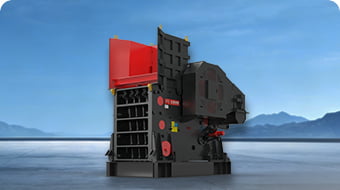
The jaw crusher is the first machine in most hard-rock production lines, not because it offers the highest reduction ratio or the best product shape, but because it tolerates the widest range of feed sizes. Run-of-mine material after blasting frequently exceeds 1000 mm, and the number of equipment types that can accept that size directly is very small.
The jaw crusher's core advantages are simple structure, a large feed opening, and good adaptability to high-hardness and abrasive materials. Its product is coarse with a higher flake content, but that is not the problem to solve at the primary stage—the job of primary crushing is to reduce large blocks to a size that the next conveyor can handle. Product shape is a downstream concern.
The capacity ceiling is real. Even the largest jaw crusher models typically max out around 1500 tph. If your project scale exceeds that threshold, the economics of a gyratory crusher begin to make sense. But for the vast majority of small and medium aggregate and mining projects, the capital efficiency of a jaw crusher is irreplaceable. The key selection parameter is not the single number for "maximum feed size," but the frequency of the largest lumps in your feed—occasional oversized blocks and continuous coarse feed have completely different effects on actual jaw crusher throughput.
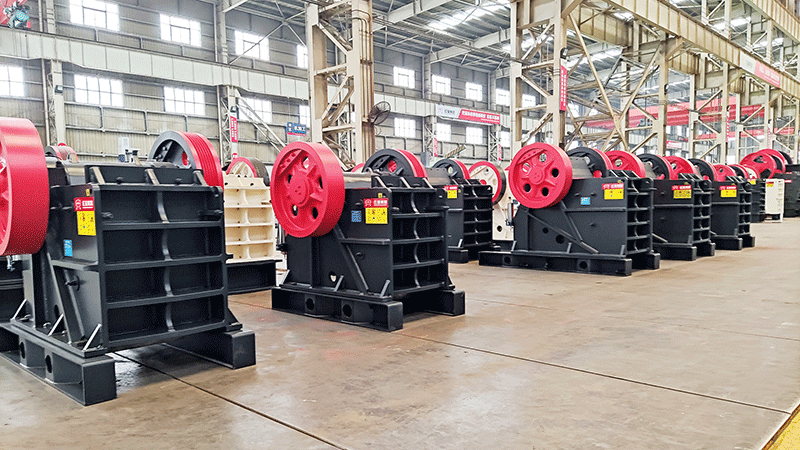
Heavy-duty jaw crushers built for continuous primary crushing operations
2. Secondary and Tertiary Crushing: The Division of Labor Between Cone and Impact Crushers
The secondary and tertiary stages are where selection errors concentrate. Cone crushers and impact crushers are often compared side by side, but they actually serve entirely different material conditions and product objectives.
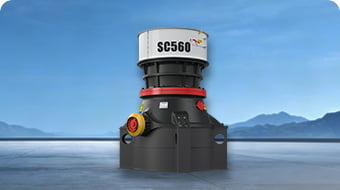
The cone crusher's domain: hard rock and abrasive material. For granite, basalt, and iron ore—high-hardness, high-abrasion feeds—the cone crusher's compressive crushing principle gives it a decisive advantage in wear-part life and operating cost. Cone crusher product is well-shaped and evenly graded, suitable as final aggregate or as pre-treatment feed for sand making. The standard configuration for hard-rock aggregate projects—"jaw for primary + cone for secondary + cone for tertiary + closed-circuit screening"—has been validated across a large number of projects.
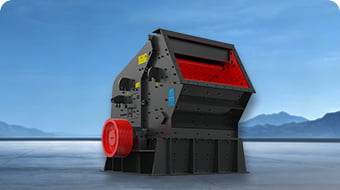
The impact crusher's window: medium-soft material and shape-critical applications. The impact crusher relies on high-speed impact crushing. It achieves a high reduction ratio and excellent cubical product content, which is why it is irreplaceable in limestone, construction and demolition waste recycling, and asphalt recycling. But the cost is equally clear: when processing highly abrasive material, the replacement frequency of blow bars and impact plates drives operating cost up quickly. An impact crusher is not incapable of crushing hard rock—it is that using an impact crusher on hard rock means the equipment cost savings will be paid back on the first year's wear-parts invoice.
A practical rule: If the feed has a high abrasion index and the product will be used in structural concrete or high-grade pavement, the cone crusher is the default choice. If the material is medium-soft limestone, or the project centers on construction waste recycling, the impact crusher's shape advantage and reduction ratio are enough to offset its wear cost.
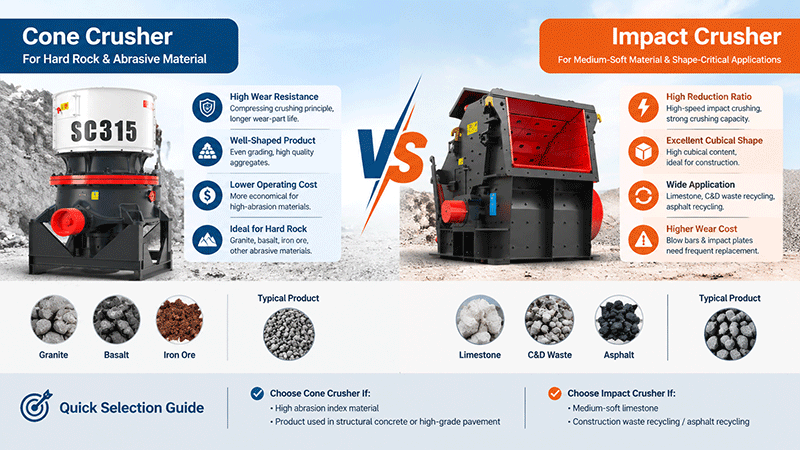
Quick selection guide: choosing between a cone crusher and an impact crusher based on feed material.
3. Sand Making and Shaping: Why VSI Is Not Replaceable
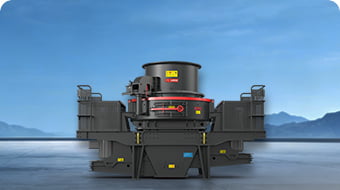
The vertical shaft impactor (VSI) plays the most distinctive role among the four equipment types: it is not designed to "make rock smaller," but to turn rock into sand while getting the particle shape right.
Traditionally, a cone crusher can produce manufactured sand by setting an extremely tight discharge opening, but the cost is a sharp increase in liner wear rate and a product shape that is not ideal. The VSI's "rock-on-rock" or "rock-on-anvil" principle fundamentally changes the crushing mechanism: material is accelerated in a high-speed rotating rotor and thrown out to collide with another stream of material or with wear-resistant anvils. This self-impact between particles both reduces direct metal wear and produces near-cubical particle shapes.
The key VSI selection question is not "can it make sand," but "what kind of sand does it make." Adjustability of fineness modulus, control of stone powder content, and the upper limit of feed size are the core parameters that differentiate the practical applicability of VSI models. If a project needs both aggregate shaping and sand production, the rotor design and crushing chamber configuration must be specified for the dominant product—a shaping-focused configuration and a sand-focused configuration are not the same in rotor speed or chamber type.
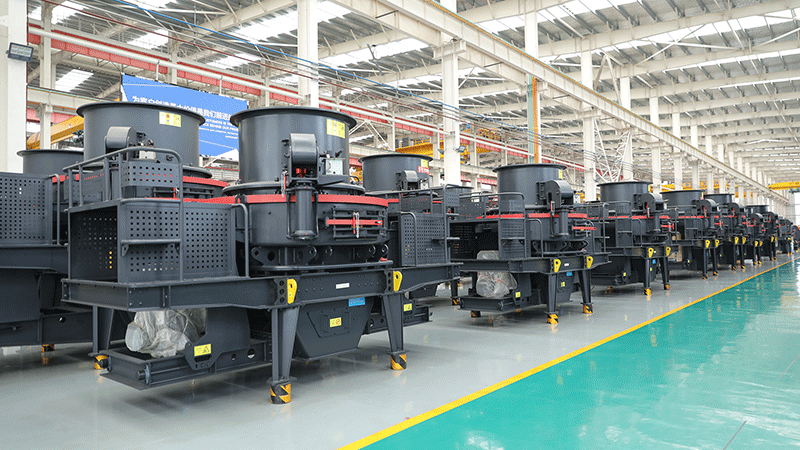
Heavy-duty VSI units configured for aggregate shaping and manufactured sand production.
4. How the Four Equipment Types Form a Line That Doesn't Waste Money
The logic of stringing these machines together is not "buy the best of everything," but ensuring that each stage's capacity and product size serve the next stage.
Standard hard-rock aggregate line: Jaw (primary, open circuit) → Cone (secondary, closed-circuit screening) → Cone (tertiary, closed-circuit screening) → VSI (shaping/sand making). The defining feature of this line is that each stage has a clear size-control target. Closed-circuit cycling in secondary and tertiary crushing ensures that oversized material does not enter the next stage. VSI intervenes only when shape improvement or manufactured sand production is required.
Limestone or construction waste line: Jaw or large impact crusher (primary) → Impact crusher (secondary/tertiary) → VSI (sand making, if needed). This line eliminates the cone crusher because the material's abrasiveness does not pose a wear-cost threat, and the impact crusher's reduction ratio advantage can simplify the flow sheet and reduce equipment count.
The most common waste: Placing an impact crusher in the secondary position to process highly abrasive granite, or forcing a VSI into the line just to "look more complete" when a qualified manufactured sand source already exists. The length of the equipment list does not equal the rationality of the production line.
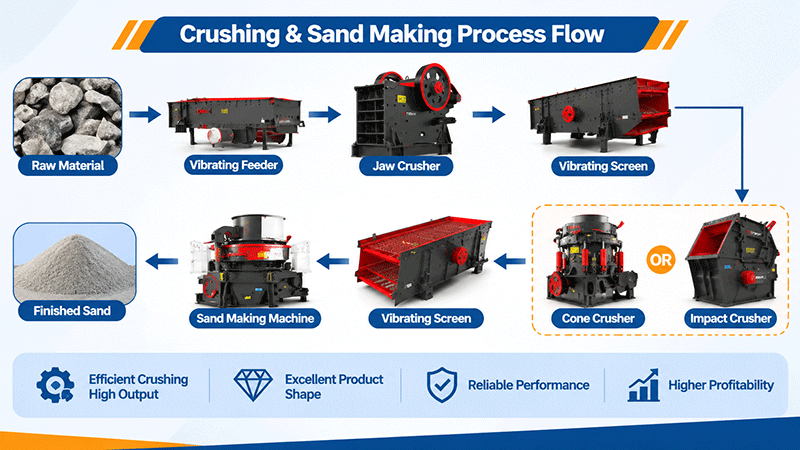
Complete crushing and sand making circuit for aggregate and manufactured sand production
Frequently Asked Questions
Both jaw crushers and impact crushers can do primary crushing. How do I choose?
Look at material abrasiveness and product objectives. Jaw crushers suit high-hardness, high-abrasion material and tolerate the widest feed sizes, but product shape is average. Impact crushers used for primary crushing deliver better shape and a higher reduction ratio, but only suit medium-soft material, and wear-part costs accumulate quickly on hard rock. If the feed is granite or basalt, choose a jaw crusher. If it is limestone or construction waste, an impact crusher in the primary position can simplify the downstream flow sheet.
Can a cone crusher be used for sand making?
Technically yes, by setting an extremely tight discharge opening, but it is usually not economical. An excessively tight setting sharply increases liner wear rate, and product shape is inferior to VSI. If the project requires scaled manufactured sand production, VSI is the more rational investment. The cone crusher's role should be secondary and tertiary crushing, preparing properly sized feed for the VSI.
What is the feed size limit for a VSI sand maker?
Typical VSI feed size limits fall in the 40–50 mm range, depending on model and crushing chamber configuration. Material exceeding this range needs secondary or tertiary crushing before entering the VSI. When selecting, do not rely solely on the nominal "maximum feed size"—confirm that throughput and wear-part life at that size are within acceptable limits.
About the Author
This guide is prepared by the process engineering team, drawing on aggregate line configuration, hard-rock crushing project selection, and on-site commissioning experience. For project-specific inquiries or to discuss equipment configuration for your material characteristics and product targets, please reach out through the contact form below.