Basalt vs. Granite: Why the Same "Hard Rock" Label Demands a Different Crusher Circuit

By:Hongxing MachineryPublication Date: 2026-11-21 17:10:21Last Updated: 2026-11-25 14:16:08

Need a Reliable Solution? Let's Talk.

Free Technical DrawingsFactory PriceGlobal Shipping

Get a Quote>

In the aggregates and quarry industry, both basalt and granite are routinely lumped together under the label of "hard rock." It is a convenient shorthand—but a dangerous one for your operating budget.

If you feed these two materials into the same crusher circuit without adjusting the wear parts and chamber profiles, you will see a massive divergence in your total cost of ownership. Basalt is highly abrasive; it grinds your equipment. Granite is highly compressive; it crushes your equipment. Using the wrong setup can easily double your wear parts cost and ruin your finished product shape.

The "Hard Rock" Trap: Why One Crusher Size Doesn't Fit All

In the aggregates and quarry industry, both basalt and granite are routinely lumped together under the label of "hard rock." It is a convenient shorthand—but a dangerous one for your operating budget.

If you feed these two materials into the same crusher circuit without adjusting the wear parts and chamber profiles, you will see a massive divergence in your total cost of ownership. Basalt is highly abrasive; it grinds your equipment. Granite is highly compressive; it crushes your equipment. Using the wrong setup can easily double your wear parts cost and ruin your finished product shape.

Data-Driven Comparison: Abrasiveness (Ai) vs. Compressive Strength

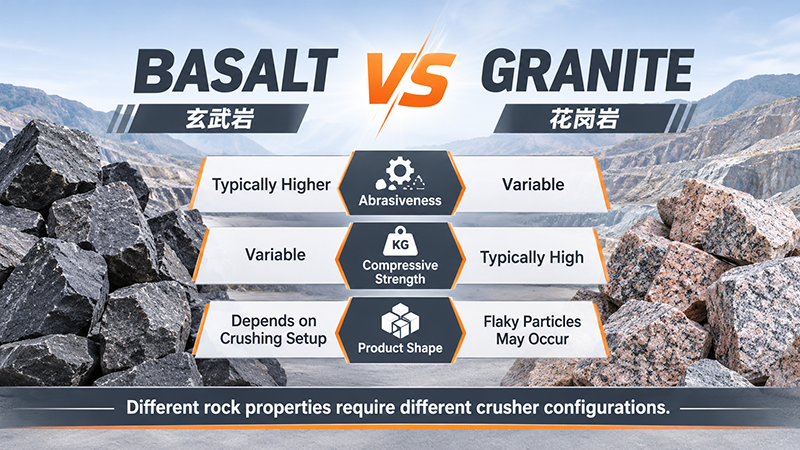
Before we talk about machines, we need to look at the physical properties of the rock. Here is how they differ on the key metrics:

Abrasiveness (Ai Index): Basalt usually contains a higher percentage of silica (SiO2). Its Ai index is significantly higher than that of granite. This means basalt is much harsher on jaw plates and cone liners, causing accelerated wear and frequent replacement.

Compressive Strength: Granite is typically denser and harder to break. It possesses a higher compressive strength, demanding crushers with robust frame structures and high crushing force to achieve the desired reduction ratio.

Product Shape: Granite has a natural tendency to produce flaky and elongated particles if crushed improperly, which often fails strict ASTM/EN aggregate standards. Basalt, due to its mineral composition, generally yields a better, more cubical shape.

basalt vs granite aggregate texture comparison

Basalt and granite require different crushing strategies

Primary Crushing (Jaw Crusher): Material Upgrade & Feed Control

For the primary stage, a Jaw Crusher is the standard choice for both materials. However, your configuration must change:

For Basalt: Because of its high abrasive index, standard high-manganese steel jaw plates will wear out too fast. We strongly recommend upgrading to high-chrome alloy or ceramic-insert jaw plates. Additionally, strictly control the feed size to avoid excessive sliding friction, which accelerates wear.

For Granite: A standard heavy-duty jaw crusher with high manganese steel plates is generally sufficient. The focus here should be on the crushing ratio and ensuring a continuous, "choke-fed" operation to maximize reduction and minimize flakiness in the primary stage.
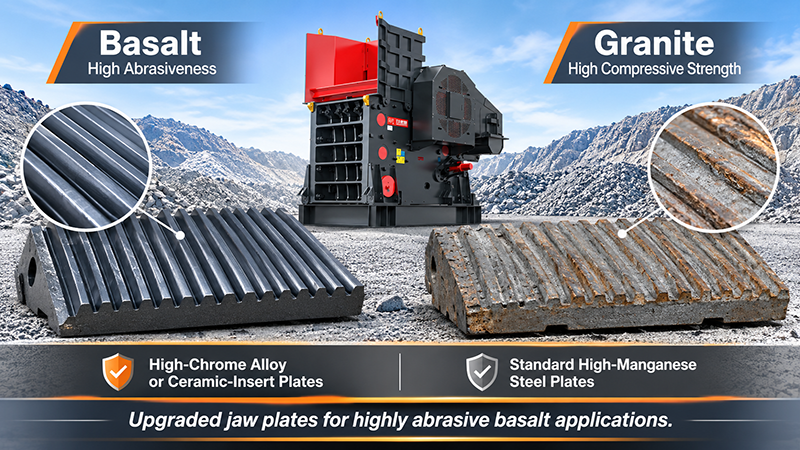
high chrome alloy jaw plate for basalt vs standard manganese jaw plate for granite

Upgraded jaw plates for highly abrasive basalt applications

Secondary & Tertiary Crushing: The Cone Crusher Chamber Dilemma

This is where the circuit design diverges most significantly. Both materials need a Cone Crusher, but the chamber type and machine model matter immensely.

Granite Focus: Lamination Crushing for Shape. Granite's biggest challenge is flakiness. A Multi-Cylinder Hydraulic Cone Crusher is the ideal choice. You must prioritize a laminated crushing chamber. By ensuring the material is choke-fed and crushed under high pressure between the mantle and concave, the flaky particles break along their weak planes, resulting in a high percentage of cubical products.

Basalt Focus: Abrasion Resistance & Throughput. For basalt, the priority shifts to reducing wear on the liners. A Single-Cylinder Hydraulic Cone Crusher (with a larger eccentric throw) or a Multi-Cylinder model fitted with a specialized heavy-duty liner is recommended. The goal is to achieve a higher reduction ratio in a single pass, reducing the recirculating load and subsequently lowering the wear on the liners.
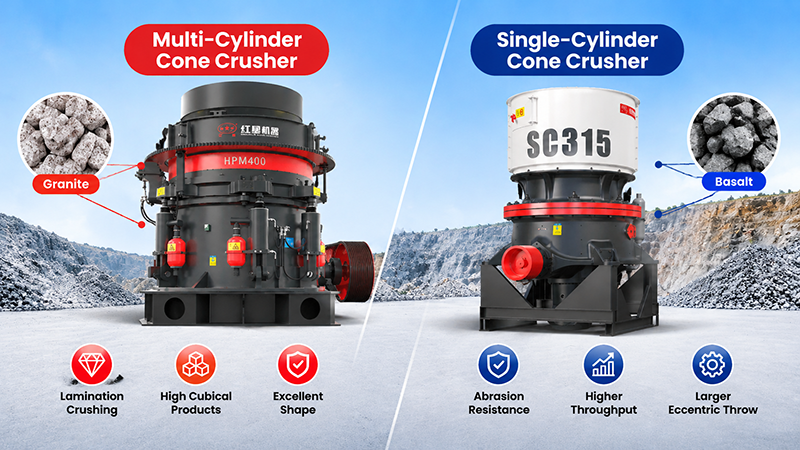
laminated crushing chamber cross section for granite and basalt

Laminated crushing chamber for improved product shape

Don't Guess—Get Your Circuit Designed

Choosing a crusher circuit based solely on the label "hard rock" is a costly mistake. Whether you are processing basalt or granite, the right combination of jaw plate material, cone crusher chamber, and feed control will save you thousands in wear parts and downtime.

Are you currently dealing with excessive wear or poor particle shape? Tell us your feed size and expected output, and our engineers will design a customized crushing circuit for your specific rock type.
Get a customized solution & factory price in 24 hours.

Get a Quote Now

· Related Blogs

Expert Support for Every Step

Our global service network is ready to provide on-site technical support, genuine parts, and 24/7 assistance for your crushing projects.

Leave a Message To Get a Quote

We will send you equipment information and a quote via email or WhatsApp.

We value your privacy. The information you share will be strictly confidential and used only to enhance our services to you.